
Prototyping
Product Prototyping and Development in Latvia
From an early idea to a functional prototype and finished product.
WE FORM SPACE helps turn an early product, furniture, lighting object, mechanism or custom-object idea into something that can be physically manufactured. We contribute technical development, make the prototype, review the result and, where suitable, continue into final production.
The practical advantage is a combination of design understanding, technical development and direct access to real joinery, metalwork, finishing and assembly. The product can be developed while it is physically made instead of being handed to a disconnected supplier only after every drawing is complete.
01
Start with what you have
A production-ready CAD model or complete drawing package is not required for an initial conversation. We can review one or more of the following starting points:
- an idea or short description
- a hand sketch or rough drawing
- a reference image and approximate dimensions
- an existing object or previous prototype
- a PDF or technical drawing
- a partial or complete CAD / 3D model
02
What we can develop and prototype
Prototyping is not limited to making a small model or a 3D-printed shape. The scope is chosen around what must be validated before final production.
Products and product development
New physical products, consumer and professional objects, branded objects, bespoke components, assemblies, one-off design objects and pre-production samples. Work can cover construction, dimensions, proportions, materials, manufacturing methods, connections, fasteners, purchased components, assembly logic and production-ready detailing.
Mechanical products and mechanisms
Functional assemblies, frames, supports, brackets, hinges, joints, pivoting elements, sliding or adjustable solutions, mounting systems and mechanical interfaces. A physical prototype can validate movement, clearances, geometry, stiffness, connections, assembly, usability and real-world physical behaviour.
Lighting objects and luminaires
Pendant, wall, table and floor lighting objects, decorative or architectural luminaire bodies, frames, mounting details and integrated lighting objects. Development can cover the physical body, construction, materials, mounting, assembly, appearance and finish; the electrical system and regulatory approval must be assessed separately.
Full-scale furniture
Chairs, stools, tables, benches, seating structures, shelving, cabinets, storage, adjustable furniture, furniture components and mechanisms. A full-size sample can validate ergonomics, seating position, proportions, stability, construction, connections, material behaviour, assembly sequence and visual balance.
Interior, architectural and retail objects
Interior details, retail and POS displays, shopfitting elements, exhibition structures, temporary installations, architectural details, full-scale mock-ups and other custom spatial objects without a ready-made standard solution.
03
Choosing the right prototype
The prototype type is selected according to the main question that must be answered before further investment.
Concept and visual prototype
Form, volume, proportions and the overall physical impression.
Functional and mechanical prototype
Movement, mechanics, connections, load path and practical use.
Ergonomic 1:1 prototype
A full-scale object for testing ergonomics, scale, stability and usability.
Material and finish sample
Material behaviour, colour, texture, surface quality and compatibility.
Connection or assembly prototype
One critical joint, fastener, connection or assembly sequence.
Pre-production sample
A production-representative reference for construction, appearance, finish and process approval.
04
From idea to production
-
01
Idea and input
A description, sketch, reference image, existing object, PDF, drawing, CAD model, dimensions and functional requirements.
-
02
Technical development
Function, geometry, proportions, construction, materials, mechanics, connections, assembly, finish, production risks and cost implications.
-
03
Prototype
A complete object or only the critical assembly, mechanism, connection, material sample or full-scale mock-up.
-
04
Testing and review
Function, movement, ergonomics, dimensions, stability, assembly, material behaviour, manufacturability and visual result.
-
05
Iteration where needed
After physical review, we refine the construction or simplify unnecessarily complex and costly solutions. Not every project needs several prototype rounds.
-
06
Finished product and manufacturing
After approval, we can continue with a final one-off object, small batch, repeated manufacturing or production for a larger project.
05
Practical development in real fabrication
More important than a long machine list is the ability to coordinate several production disciplines in one project and make decisions grounded in physical manufacturing.
Joinery
Solid wood, plywood, bent-laminated plywood, MDF, veneered and other furniture boards; component fabrication and coordinated construction.
Metalwork
Steel, stainless steel, custom metal parts, frames, supports and mixed-material structures.
Finishing
Surface preparation, painting and finishes selected for the material, use and intended physical result.
Assembly
Mechanical assembly, custom fasteners, purchased components and coordination of timber, metal and finished parts.
06
Why make a physical prototype
- validate proportions, ergonomics and dimensions at real scale
- review mechanism movement, clearances and connections
- test assembly, fasteners and the manufacturing sequence
- confirm materials, colour, texture and surface finish
- identify unnecessary complexity or expensive construction decisions
- reduce risk before final production and create a reliable pre-production reference
Prototype and final production with one team
The information learned during prototyping stays with the same team that can manufacture the finished object. Approved materials, connections, components, assembly sequence and finish do not need to be translated for another supplier. Where suitable, one functional sample can therefore lead directly to a finished unit, small batch or repeated production.
07
Prototype pricing
Price depends on the amount of development required, size, complexity, materials, mechanisms and purchased components, manufacturing operations, preparation, finish, testing, number of iterations and intended quantity.
The first unit often has a higher per-unit cost than later manufacturing because technical development, programming, preparation, setup and testing are concentrated in that first object. Once approved, that work can be distributed across subsequent units.
08
Related manufacturing experience
The completed mixed-material, furniture and custom-object work below demonstrates manufacturing experience; it is not presented as a portfolio of prototype projects.
Interior furniture
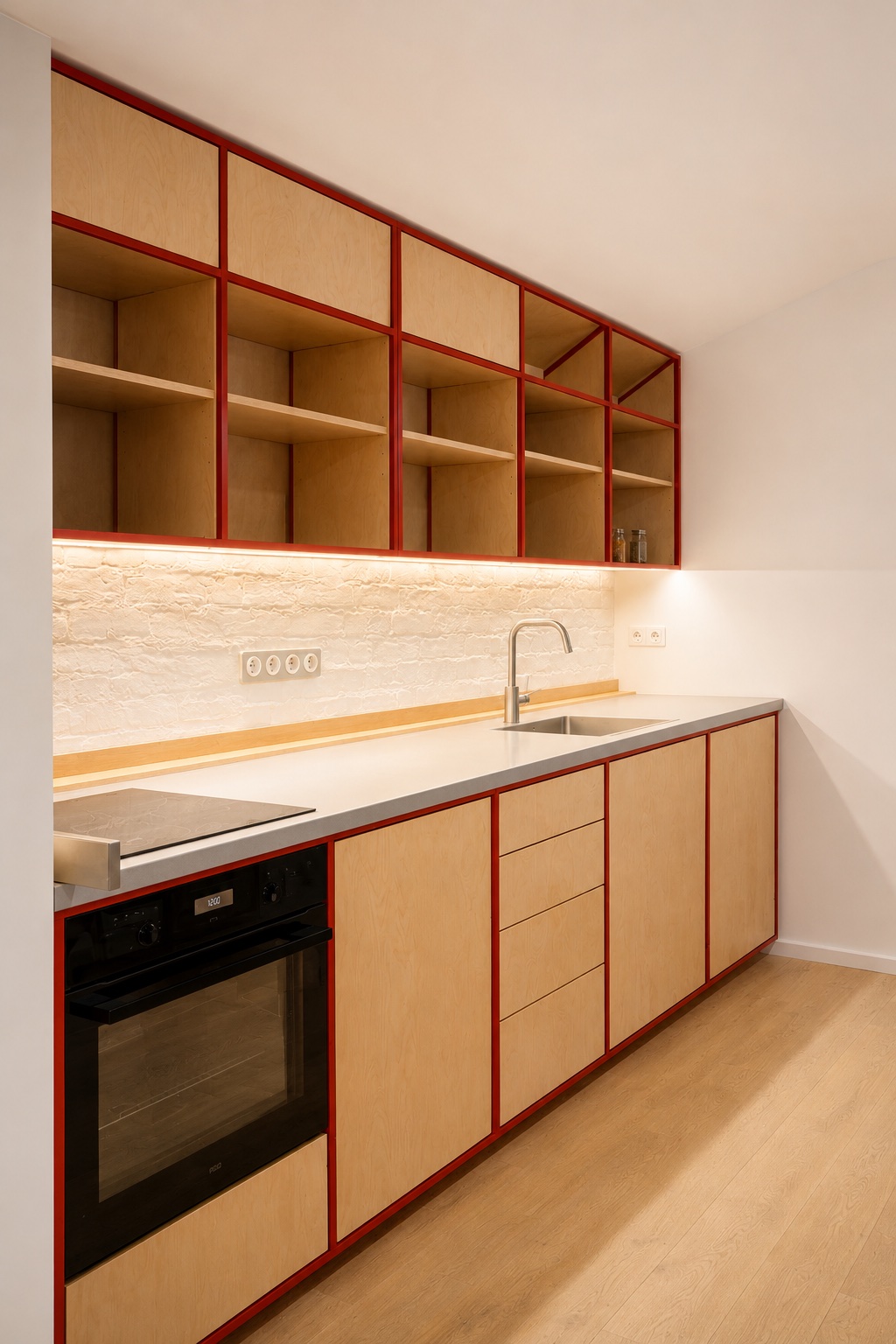
Custom kitchen
Birch plywood kitchen with red steel framing, a stainless steel countertop, and integrated lighting.
View project
Hospitality interiors
Red bar fit-out
Custom red metal bar elements, including a glass rack, counter cladding and spatial dividers, made for a hospitality interior.
View project
Custom spatial objects
Sculptural wood object
A freestanding curved and tapered wood object made for an exhibition setting.
Artist Amanda Ziemele
View project09
Send an idea, sketch or technical brief
Briefly describe what must be developed, how the object should work, the current project stage and what the prototype must help validate. A complete technical package is not required.
What to include in the project brief
- the intended function and current project stage
- approximate dimensions and intended quantity
- material and finish requirements, if known
- desired deadline and the main risks to be tested
- available PDF, JPG, PNG, STEP / STP files, drawings or sketches
In your first message, tell us which files you have. After receiving the enquiry, we will agree on an appropriate secure transfer method.
This service does not replace certified engineering, safety calculations, CE conformity assessment or electrical certification where a particular product requires them.